
Farmhouse kitchens, hutches and pantry cupboards in Dane
For kitchens in the village of Dane that grew over the decades: cabinets of different ages, a hutch or pantry cupboard, beadboard, and paint beside natural wood.
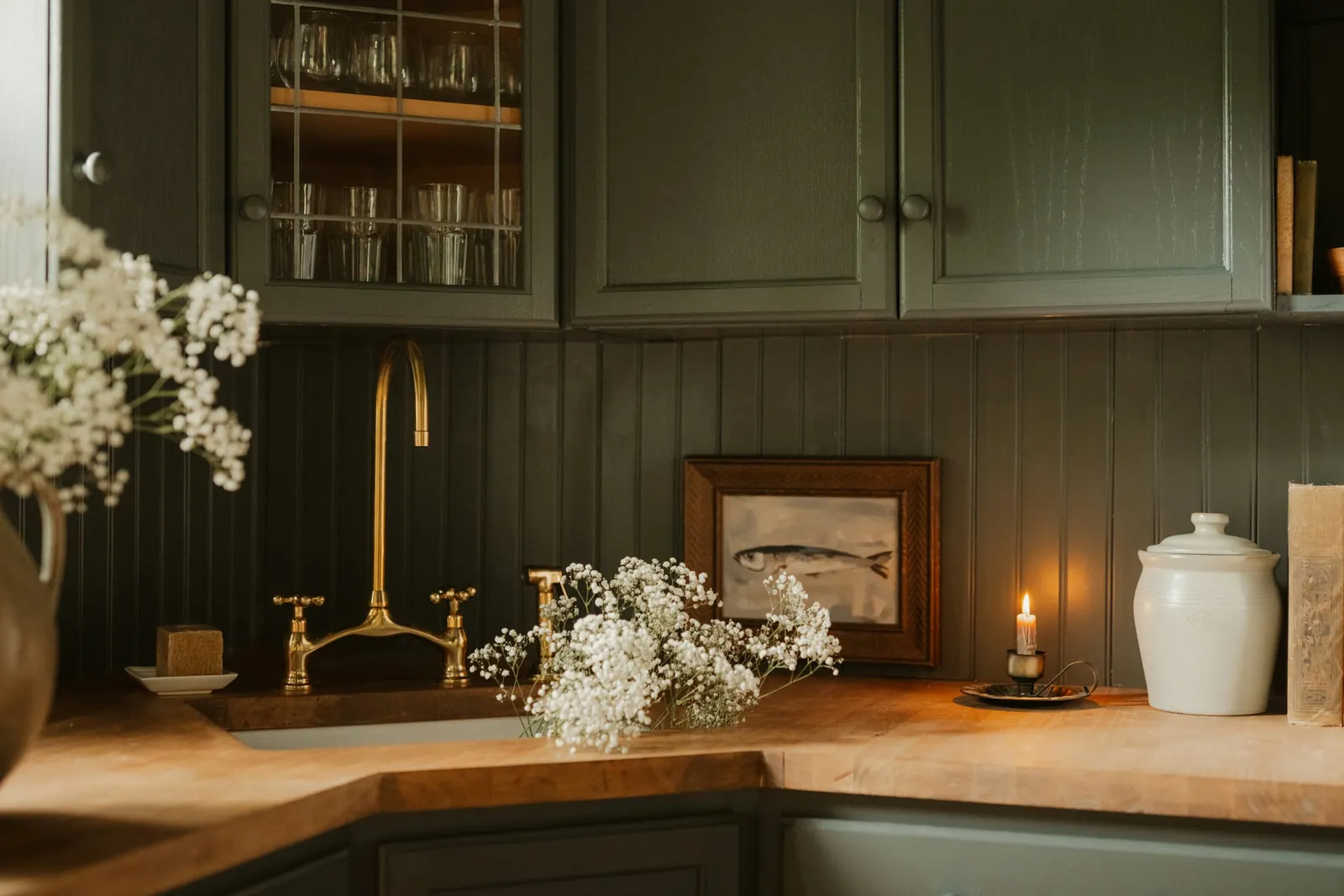
A run of cupboards from one decade, an addition from another, a hutch that came with the house: plenty of kitchens in the village of Dane carry more than one owner's ideas. About 17% of homes here were built before 1940 and about 84% are single-family houses, so the kitchen usually works, but nothing in it quite belongs together.
This page is about pulling a kitchen like that into one look. It covers cabinets of different ages under one color, the freestanding pieces that go with them, beadboard, and how painted cabinets sit beside butcher block and old wood floors.
A kitchen built in stages
Older houses rarely keep their first kitchen whole. A familiar pattern is original cupboards on one wall, a newer run of base cabinets added when the counters were redone, and a home-center set in a later addition. Each has its own wood, its own stain and its own door style.
Paint is very good at quieting that. Stained, painted, laminate and unfinished cabinets can all be refinished, and once every section shares a color and a sheen, the mix of door styles reads as character instead of patchwork. Each material gets its own prep: grease and loose finish come off, slick surfaces are sanded, and everything is primed before the color.
What paint can't change is the size of the boxes. If one section is deeper or taller than its neighbors, a shared color will make it match without making it line up, and that's worth seeing honestly before you decide. Our main cabinet refinishing page walks through the process start to finish.
The hutch, the pantry cupboard and other loose pieces
Farmhouse kitchens often have furniture doing a cabinet's job, like a hutch against the dining wall or a tall pantry cupboard beside the back door. Pieces like these can be refinished with the kitchen, their doors and drawers sprayed and their cases finished the way the cabinet frames are.
There are two good routes. Match the kitchen exactly and the piece becomes part of the room. Or give it a planned contrast, such as a deeper shade of the kitchen color, and it reads as a piece of furniture that has been in the house for years. What rarely works is a near match that's just a little off.
If a piece has real age and an original finish you love, it's fair to ask whether it should be painted at all. Our post on painted vs stained cabinets helps with that call.
Beadboard panels and open shelves
Beadboard turns up on farmhouse cabinets as door panels and on the exposed ends of a cabinet run. The narrow grooves are the hard part, because a brush leaves paint pooled in the bottom of each one. That's one reason the doors and drawer fronts come off and are sprayed, which lays the finish into the grooves evenly.
Everything fixed in place, the face frames, the beadboard end panels and the toe kicks, is finished right in your kitchen. Those surfaces are cleaned, sanded and primed the same way, with old grime picked out of the grooves first so nothing gets sealed under the new paint.
Open shelves and the backs of glass-front cabinets are a separate question, because what shows inside a cabinet isn't the same job as its doors and frames. Point them out on the visit so you know exactly what the plan covers.
Deep green, cream and the farmhouse palette
Deep green and cream are classic choices for an older kitchen, and they behave very differently. Paint chips often list a light reflectance value, or LRV, which measures how much light a surface bounces back. A deep green sits low on that scale and a warm cream sits high, so the same kitchen feels snug in one and bright in the other.
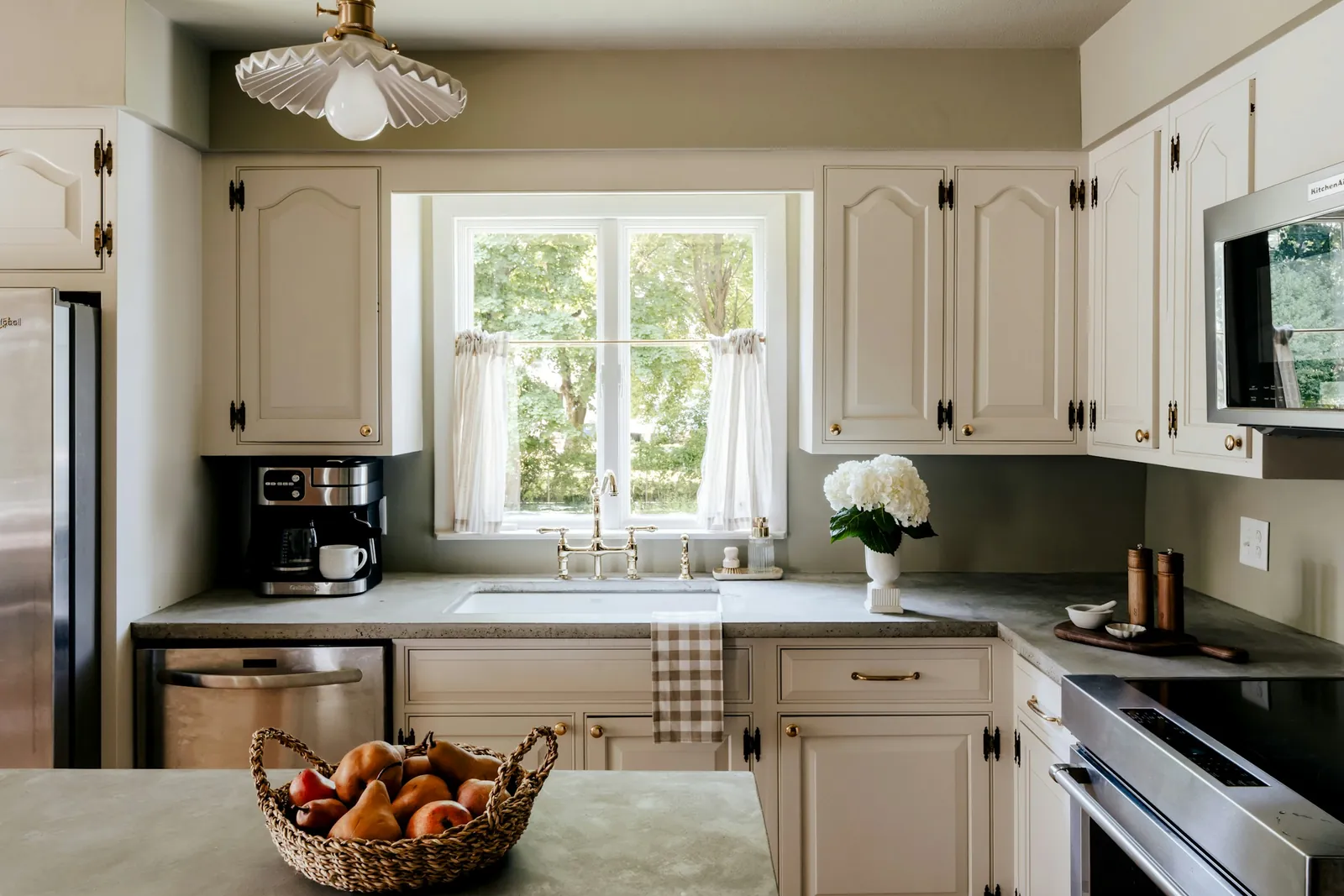
Deep green can feel heavy in a farmhouse kitchen with small windows, but not always. It does best with light counters, a pale wall and good evening lighting, or on the lower cabinets or an island with cream above. Dark colors also take longer to harden: Dunn-Edwards says colors with a heavy load of pigment usually take longer to dry and cure than light ones.
Our posts on green kitchen cabinets and navy kitchen cabinets go deeper into dark colors, and these maple cabinets refinished in forest green show a deep green against granite counters and a pine ceiling.
Next to butcher block, wood floors and a stained accent
Most farmhouse kitchens keep some natural wood: a butcher block top, an old floor, an open beam, a stained table. Painted cabinets look their best when they let that wood be the warm note in the room. Cream and green both do this well, while cool grays and stark whites can make old wood look orange beside them.
A butcher block top on an island is usually best left as wood, with the island base painted. Counters stay where they are during refinishing, so the block is covered and protected while the cabinets under it are worked on.
One stained piece can stay stained on purpose. A hutch or an island kept in its wood tone, surrounded by painted cabinets, gives the eye one place to rest. Choose the cabinet color with that piece in view, holding the sample right against it.
Estimates in the village of Dane
Dane sits on Highway 113 north of Waunakee, where we're based, so the village is an easy drive for us. George does the estimate himself: he looks at each section of cabinets, notes what it's made of and how it was finished before, and counts the doors and boxes. Refinishing is priced per cabinet, paint included, and the estimate is free.
Most kitchens take one to two weeks. A hutch, a pantry cupboard or a second run of cabinets adds to the count, so name every piece you're considering when you call. Carley handles the schedule, and we work Monday to Friday, 8am to 5pm.
Paying is simple too: Apple Pay, Venmo, Zelle, a check or cash all work. Ask for a free estimate, or read more about homes in the village of Dane.
Common questions
Can a freestanding hutch be refinished to match the cabinets?
Yes. A hutch gets the same cleaning, sanding, priming and sprayed doors as the kitchen, so it can match exactly or take a planned contrast. Bring it up on the first call so it's part of the same quote.
Is deep green too dark for an older farmhouse kitchen?
Not if the room has some light to work with. Pair it with a light counter and a pale wall, or keep it on the lowers or an island with cream above. In a kitchen with one small window, a lighter sage or a cream is the safer pick.
Can cabinets with beadboard panels be painted?
Yes. Beadboard doors are sprayed so the paint fills the grooves evenly instead of pooling, and fixed beadboard end panels are finished in place. Grime in the grooves is cleaned out before any primer goes on.
Do you give estimates in the village of Dane?
Yes. The village is a short drive up Highway 113 from our base in Waunakee, and estimates are free. George looks at the cabinets in person and follows up with a written quote.
Should a butcher block island top stay natural wood?
Usually, yes. Natural wood on top balances the painted cabinets around it, and the counter stays in place, covered, while the island base underneath is refinished.
More in Dane
Cabinet refinishing nearby
Helpful guides
Sources
- American Community Survey 2020-2024 5-year estimates, U.S. Census Bureau, via Census Reporter
- Light reflectance value, Wikipedia
- Dry Time versus Cure Time of Paint (technical bulletin), Dunn-Edwards
- Dane, Wisconsin, Wikipedia