
Painting the honey oak cabinets in DeForest's 1990s kitchens
A bigger share of DeForest's homes dates from the 1980s and 1990s than in any other town we serve, so the kitchen question here is usually golden oak.
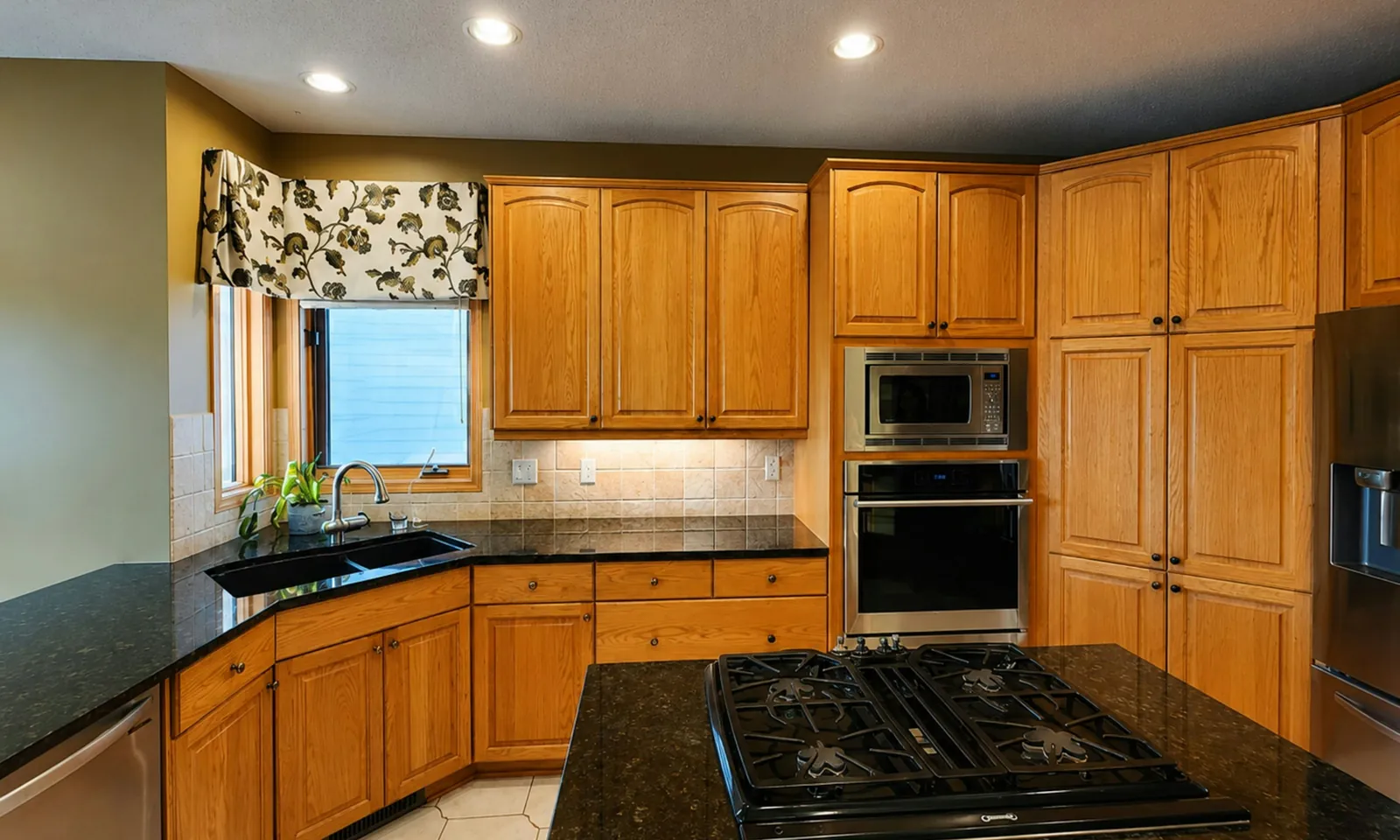
Honey oak doors with a raised center panel, a golden finish slowly deepening toward amber, a row of small knobs: anyone who grew up in the 1980s or 1990s knows that kitchen, and DeForest has a lot of them. Roughly 41% of homes in the village date from 1980 through 1999, the largest share of any town we work in.
Those cabinets are usually solid and worth keeping. The questions are about the wood itself: how oak grain looks under paint, how a raised panel takes a sprayed finish, and which colors sit well with the oak floors and newer counters that are staying. For the village's houses in general, see painting in DeForest.
Why so many DeForest kitchens are oak
The village did much of its growing during the two decades when golden oak was the default cabinet. The Census puts about 41% of DeForest homes in the 1980 to 1999 window, with the median home dating to 1993. Waunakee, which has the next highest share among the towns we serve, has about 36% from those years.
In plenty of these houses the original kitchen is still in place, sometimes with a newer counter, sink or floor added along the way. That mix of old cabinets and newer surfaces is exactly where refinishing earns its keep, because the parts that cost the most to replace are already updated.
It's also a village where people stay. About 78% of homes are owner occupied, so whoever decides about the cabinets usually plans to live with the result for years. That makes it worth knowing what paint will and won't do to oak before you pick a color.
Oak grain under paint: what shows and what to expect
Oak is an open-grained wood. The Forest Products Laboratory's Wood Handbook groups it with ash, hickory and walnut as hardwoods with large vessels, the pores behind oak's pattern, while maple and cherry have small ones. Paint follows those pores instead of bridging them, so after refinishing, the grain is still there as a fine texture under the new color.
Many owners like that look, since the cabinets still read as wood. If you're picturing a glass-smooth slab, tell George at the estimate so you can talk through what oak can give you. Sheen changes how much you notice: Dunn-Edwards notes that higher gloss makes surface flaws easier to see, so satin keeps the texture quieter than semi-gloss.
Oak also carries tannins, and an American Coatings Association article explains that wood extractives like these can move into a fresh water-based coat and discolor it. Every cabinet is primed before color, and on oak going white or pale, the primer is what keeps the tannins sealed in. Our guide to painting oak cabinets covers both effects.
Raised panels and spraying: an even coat in the profiles
A raised-panel door isn't flat. The center panel is framed by a sloped bevel and a recessed groove, and the frame around it has its own edge profile. Brush a door like that and paint pools in the inside corners, sags off the bevels and leaves brush lines that catch the light.
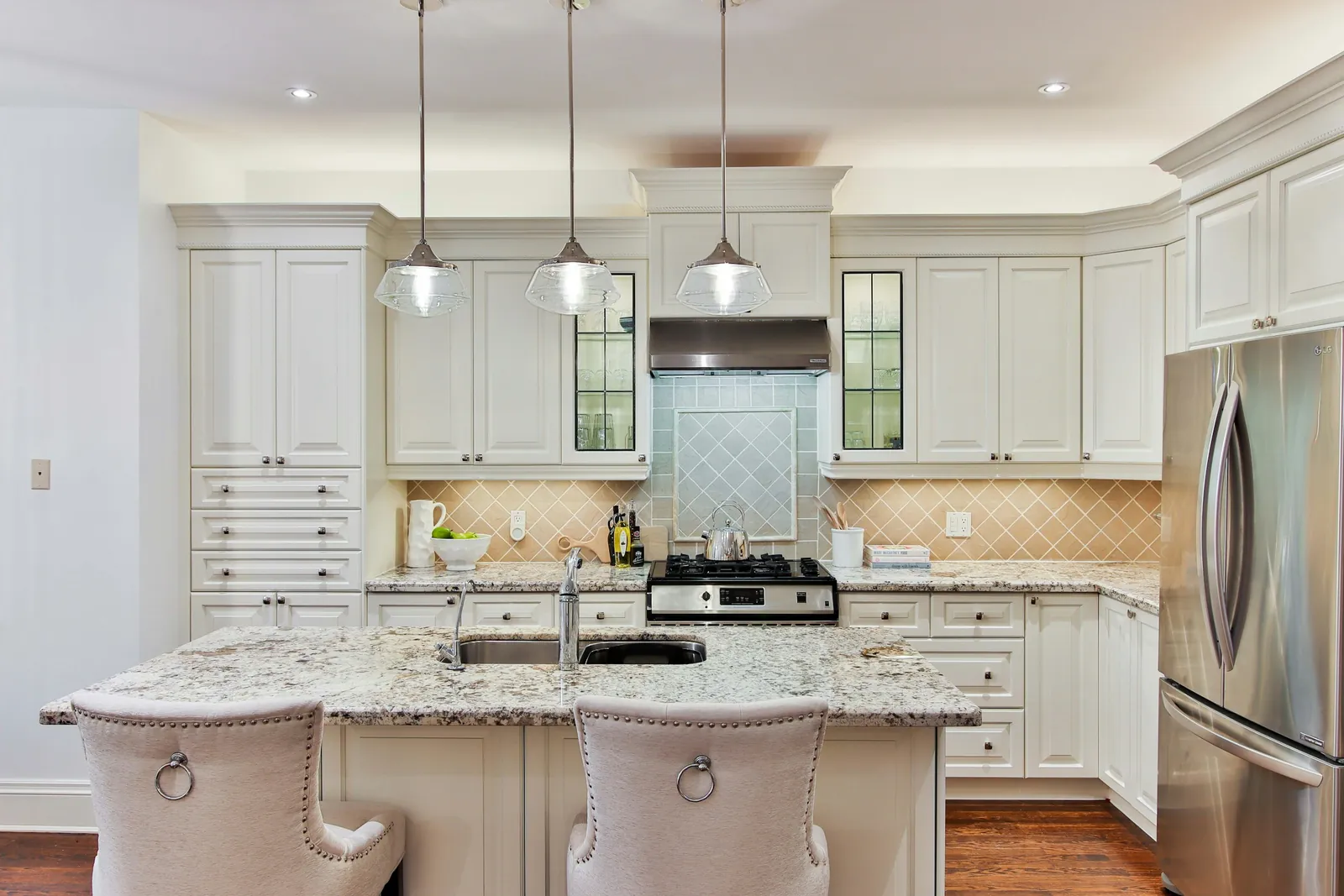
That's why the doors and drawer fronts are taken down and sprayed, which lays a thin, even film into every profile and lets it level as it dries. The grooves are also where decades of kitchen grease hide, so they're degreased and scuffed along with the flat faces before primer. Our post on how to paint kitchen cabinets walks through each step.
Choosing a color that works with the oak and counters that stay
In a lot of DeForest kitchens the cabinets aren't the only oak. The floor or the nearby trim may be the same golden wood, and the counter may be a newer granite or quartz. Start the color choice from what's staying, not from a photo of someone else's kitchen.
Next to a honey oak floor, colors with a little warmth usually look best: creamy whites, warm greiges, sage and olive greens, or a deep navy that lets the floor's gold stand out. Bright whites with a cool, bluish undertone can make the oak look more orange by contrast.
Paint a sample on a spare board or the back of a door, stand it on the floor beside the cabinets, and look at it in morning and evening light before you commit.
The order of work in a 1990s kitchen
- Counters, floors and appliances are covered.
- Doors and drawer fronts come off, each labeled with its own hinges so it returns to the same opening.
- Every surface is cleaned, degreased and sanded, then primed.
- Doors and drawer fronts are sprayed, while the face frames and cabinet sides are finished in place.
- Everything is rehung, and the hinges are adjusted until the gaps line up.
- At the end, we go over the kitchen with you, door by door.
Most kitchens take one to two weeks. Pricing is per cabinet with paint included, and the paint is premium Sherwin-Williams or Behr unless you'd rather pick another brand; our cabinet paint comparison explains how the main types differ. The written quote is the price, no extra charge if the job takes longer than expected. Our main cabinet refinishing page lists everything that's included.
Oak elsewhere in the house: keep it or paint it
Houses from this era rarely stop at the kitchen. Bathroom vanities, a built-in desk and the casing around every door may all be the same oak. Vanities and built-ins can be refinished the same way as the kitchen, on the same schedule or later.
You don't have to paint everything. Painted cabinets next to stained oak trim can look deliberate, especially when the cabinet color has some warmth in it, and plenty of owners keep the trim as the room's one wood note. If you're weighing the walls too, our page on interior painting in DeForest covers the tall foyers and great rooms that came with many of these houses, or request a free estimate if you'd like George to look at the whole floor.
Common questions
Will the oak grain show through once the cabinets are painted?
Yes, the grain stays visible as a light texture, because paint settles into oak's open pores instead of lying flat over them. A satin sheen makes it less noticeable than semi-gloss.
What cabinet colors work with honey oak floors?
Warm colors usually work best beside a honey oak floor: creamy whites, warm greiges, soft greens or a deep navy. Cool, bright whites can make the floor look more orange, so test a big sample next to it first.
Do raised-panel doors look dated once they're painted?
Usually not, because what dates a 1990s kitchen is mostly the golden stain rather than the door shape. Painted a current color and fitted with new pulls, a raised panel reads as traditional, not old.
Can I paint the cabinets and keep the oak trim?
Yes, painted cabinets can sit comfortably beside stained oak trim. Pick a cabinet color with some warmth in it so the wood and the paint look like they belong together.
How do we cook while the doors are out?
Most households keep cooking, because the cabinet boxes, counters and appliances stay where they are. Plan on doorless shelves for a week or so, and easy meals on the days the frames are painted.
More in DeForest
Cabinet refinishing nearby
Helpful guides
Sources
- American Community Survey 2020-2024 5-year estimates, U.S. Census Bureau, via Census Reporter
- Wood Handbook: Wood as an Engineering Material (FPL-GTR-282), USDA Forest Service, Forest Products Laboratory
- Selecting Paint Gloss, Dunn-Edwards
- Understanding Extractive Bleed, CoatingsTech, American Coatings Association