
Painting the tall rooms in DeForest's 1980s and 1990s homes
Many DeForest houses from the 1980s and 1990s came with a vaulted great room or a two-story entry. Here's what painting at that height really involves.
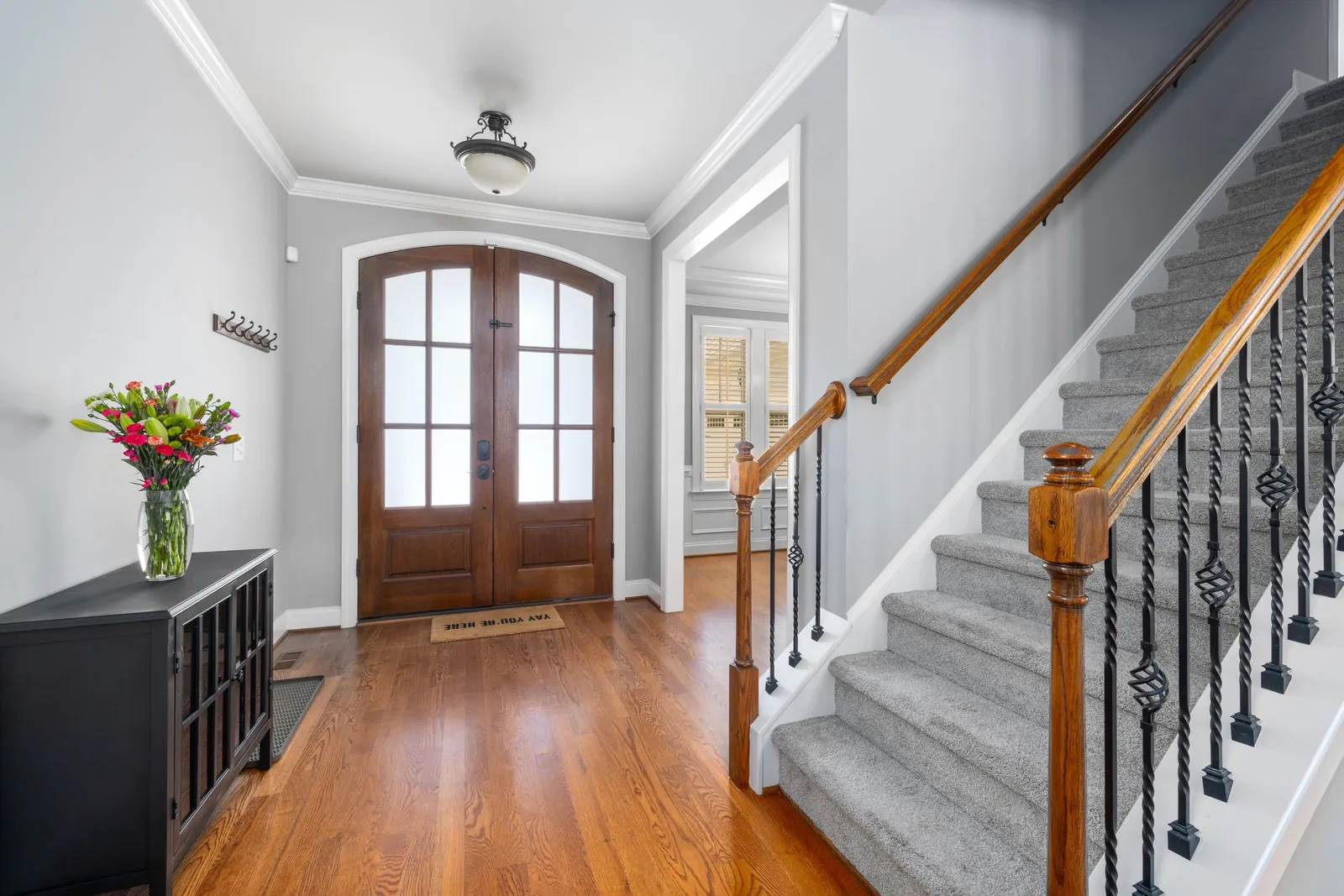
The vaulted great room, the two-story foyer with a window over the front door, the stairwell open to the upstairs hall: those are often the rooms nobody has repainted, because nobody can comfortably reach them. In DeForest, where about 41% of homes were built between 1980 and 1999, the era of the cathedral ceiling left plenty of them.
This page is about that height: what a vaulted room needs, how the high walls are reached safely, how to keep a big ceiling free of roller marks, where the wall color should stop, and why tall rooms take longer. For the village's houses in general, see our DeForest page.
Vaulted ceilings and great rooms of the era
A great room from the late 1980s or 1990s often has a ceiling that climbs from an ordinary wall height on one side to a peak far overhead, with a skylight, a row of high windows or a plant ledge somewhere along the way. From the couch it looks like one simple surface.
Up close, each of those features adds work at height. A plant ledge has a top, a front and an underside to cut around. A skylight well is four short walls and a lot of corners, and high windows throw glancing light across the ceiling for part of every day.
Thirty-odd years of dust and cooking film also settle on upper walls and ledges that never get wiped, so those surfaces are cleaned before any primer or paint goes on.
Two-story foyers and stairwell walls: reaching them safely
The tallest wall in many of these houses runs beside the stairs, from the entry floor to the upstairs ceiling. It's also the hardest to reach, because ladders want solid, level footing and stairs give them none.
Ladder guidance from the University of Washington covers the essentials: set a straight ladder one foot out from the wall for every four feet of height, keep three points of contact, never stand above the third rung from the top, and never prop a ladder on a box or anything else to gain height. It also says to move the ladder rather than lean out to reach.

On the stairs, that means equipment that stands level on uneven steps, moved many times over the course of the work, with the treads and the floor below covered first. Our post on painting a stairwell explains why this is the part most homeowners would rather hand off.
Ceiling paint and roller marks up high
A big sloped ceiling is the least forgiving surface in the house. Dunn-Edwards' ceiling bulletin says light hitting a surface at a low angle throws tiny shadows that reveal every irregularity, and it recommends careful prep and a dead flat paint overhead rather than anything glossy. Under a skylight or a row of clerestory windows, that raking light shows up every afternoon.
The other risk is a dried edge. On a vaulted ceiling, the roller works in long strips from the low wall toward the peak, each new pass overlapping paint that's still wet, because rolling over a strip that has begun to dry leaves a lap line you'll see from the sofa. Our posts on how to paint a ceiling and choosing ceiling paint go deeper on both.
Where wall color meets a sloped ceiling
In a vaulted room, the line between wall and ceiling isn't always obvious. On the side walls it's the corner where the vertical wall meets the slope. On the gable end, the wall itself rises to the peak in a tall triangle, and someone has to decide whether that triangle counts as wall or ceiling.
The usual choice is to treat every vertical surface as wall, carry the wall color up the gable to the peak, and paint every sloped surface the ceiling color. That keeps each cut line on a real corner, where it can run straight.
If the drywall corners wander, painting the slope in the wall color, or a lighter version of it, hides the wobble and makes a very tall room feel a little cozier. Settle it before painting starts, because it decides where every cut line goes.
Working around high fixtures, fans and smoke detectors
Tall rooms tend to put their electrical fixtures up high too: a chandelier in the foyer, a ceiling fan at the peak of the great room, recessed cans in the slope and a smoke detector near the top of the stairs. Each one is a spot to cut around from a ladder.
- Dust the fan blades a day or two ahead, because dust shaken loose from a blade drops straight into wet paint.
- Switch the fan and lights off at the wall before work starts, and leave them off until the ceiling is dry.
- A smoke detector should never get paint on it, so point out every detector and alarm on the high ceilings before the work starts.
- Mention any fixture that's loose or wobbles. That's a job for an electrician before it's a job for a painter.
Why tall rooms take longer, and pricing by square footage
A two-story wall comes with everything height brings: ladders and planks set up, moved and set up again, cutting in done at arm's length, and paint carried up and down. A bedroom might take a day, while a great room with a vaulted ceiling and a foyer beside it sits at the long end of the usual one to two days per room, and sometimes beyond it.
Interior painting is priced by square footage with paint included, so a tall room's extra surface shows up in the quote, and George will want to see the height, or hear about it, before he writes it. The written quote is the price, no extra charge if the job takes longer than expected.
Read more on our interior painting page, see what the oak kitchens in these houses need on cabinet refinishing in DeForest, or book a free estimate.
Common questions
Can you paint a two-story foyer?
Yes, two-story foyers and the stairwell walls beside them are part of our interior painting. They take longer than a standard room because of the ladder work, and the floor and stairs are covered first.
Should a vaulted ceiling be painted the wall color?
Usually the sloped surfaces look best in the ceiling color, with the wall color carried up the gable ends to the peak. Painting the slope the wall color is the better choice when the corners are uneven or you'd like a tall room to feel cozier.
Do you paint ceilings?
Yes, ceilings are part of interior painting, vaulted and sloped ones included. A flat finish is the usual choice overhead, because it hides the ripples that raking light picks out.
How do you reach the top of a stairwell wall?
With a ladder setup that stands level on the stairs, never a ladder balanced on a tread or propped on something. It gets moved many times as the work climbs, which is a big part of why stairwells take longer.
Do tall rooms cost more to paint?
Usually, yes, because a tall room has more surface and slower ladder work than a standard room with the same floor area. Interior work is priced by square footage, paint included. The written quote is the price, no extra charge if the job takes longer than expected.
More in DeForest
Interior painting nearby
Helpful guides
Sources
- American Community Survey 2020-2024 5-year estimates, U.S. Census Bureau, via Census Reporter
- Ladder Safety, University of Washington Environmental Health and Safety
- How to Paint a Ceiling (technical bulletin), Dunn-Edwards