Refinishing or refacing: what each one does to your cabinets
· 6 min read · By GK Painting & Remodeling
Refinishing keeps the doors and drawer fronts you have and changes their color and finish. Refacing usually replaces the doors and drawer fronts and covers the faces of the cabinet boxes with new veneer or laminate, so the look changes more and so does the amount of work.
Both leave your boxes, counters and layout where they are, which means both only make sense when the cabinets are in sound shape. We refinish cabinets, so you should know where we stand. We'll still explain refacing fairly, because the right choice depends on what's wrong with your kitchen, not on who you call. The third option, new cabinets, gets its own treatment in our guide to painting or replacing kitchen cabinets.
What refinishing changes
Refinishing is the cleaning, sanding, priming and painting of the cabinets you already have. The doors and drawer fronts come off and are labeled, then sprayed. The frames are finished in your kitchen. Everything goes back on, and the hinges are adjusted so the doors hang straight. That's the order of work on every cabinet refinishing job, and most kitchens take one to two weeks.
What you end up with is the same cabinets in a new color and a smooth new finish. The door style stays what it is: a flat panel is still a flat panel, and a raised panel is still raised. It works on stained, painted, laminate and unfinished cabinets, and the deciding factor is less the material than the condition. The boxes need to be solid, and the doors need to be in good shape under the finish.
What refacing changes
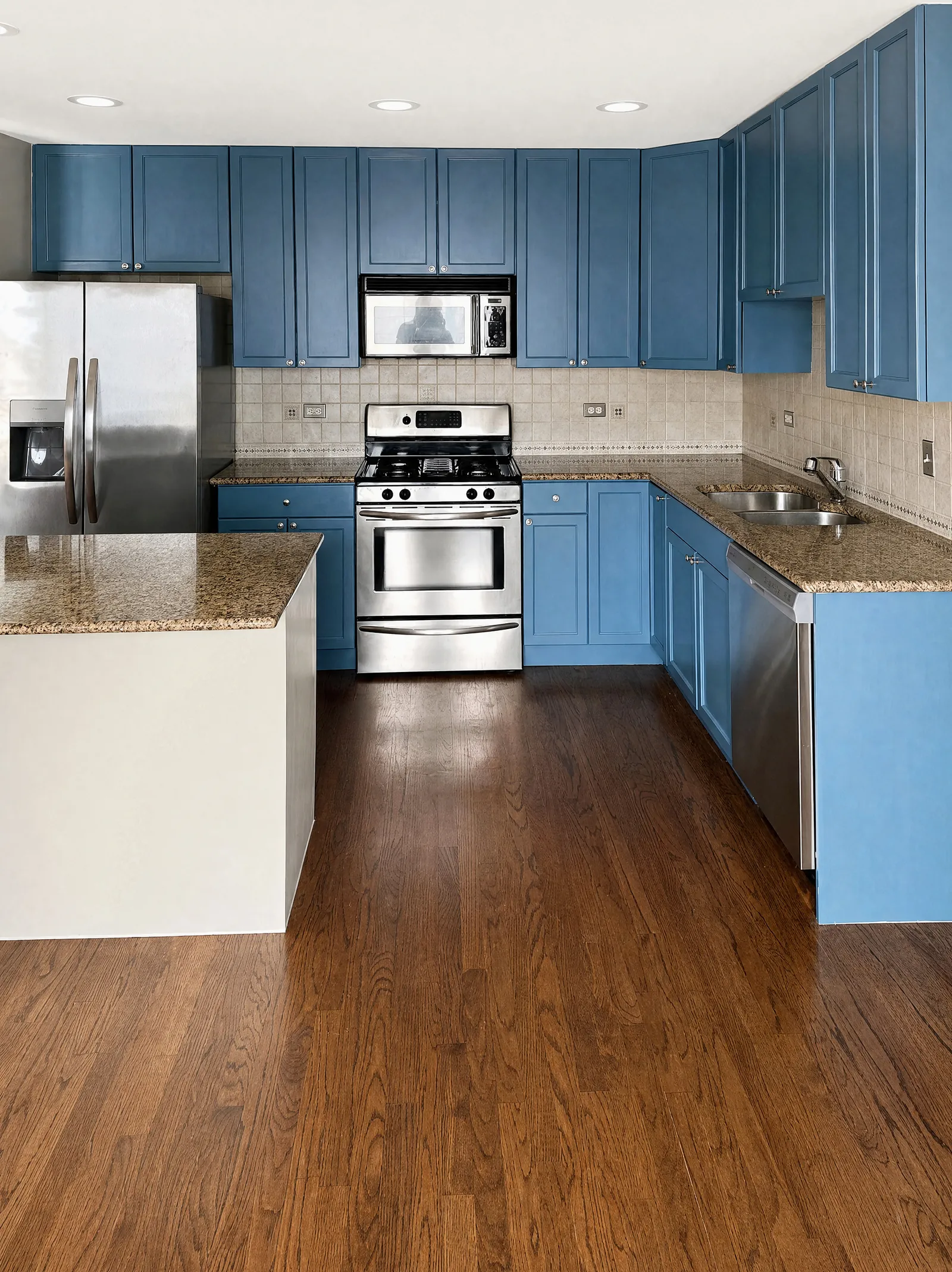
Refacing is a different kind of job. As This Old House describes it, an installer applies veneer to the face frames and exposed sides of the existing boxes, and the doors are often replaced to match. The boxes and the layout stay. The surface you see is new material.
Consumer Reports describes it the same way: a pro swaps the old doors and drawers for new ones, then covers the front and sides of the boxes with a matching finish, such as wood veneer or laminate.
That's why refacing can change a kitchen's look more than paint can. A new door style comes from the new doors. The same This Old House article is also blunt about what refacing can't do: it won't fix a layout that doesn't work, and it does nothing for countertops you don't like. Refinishing has exactly the same limits.
Refinishing and refacing side by side
| Question | Refinishing | Refacing |
|---|---|---|
| Doors and drawer fronts | Kept and sprayed in a new finish | Usually replaced |
| Cabinet boxes | Cleaned, sanded, primed and painted | Faces and exposed sides covered in veneer or laminate |
| Door style | Stays the same | Can change |
| Color change | Any paint color | Whatever the new material offers |
| Layout | Unchanged | Unchanged |
| Boxes must be sound | Yes | Yes |
When each one is the better fit
Refinishing fits when
- You like the door style you have and mainly want a new color or a cleaner finish.
- The boxes are solid, with no water damage or sagging shelves.
- You're keeping the counters, backsplash and layout.
- You'd rather not order new doors and wait for them to arrive.
A good picture of the idea is cherry cabinets refinished in light gray. The glass-front uppers kept their glass, the counters and backsplash stayed, and only the finish changed. Our guide to cabinet painting before and after photos shows how to check what changed in any pair.
Refacing fits when
- You want a different door style, not just a different color.
- The doors themselves are worn, warped or cracked beyond what a new finish can hide.
- The doors are thermofoil that's peeling. Paint can't hold down a film that's lifting away.
- You want the look of a wood veneer.
Those last two are honest limits. Paint gives you a new color, not a new wood species. If you're picturing a different wood, say so on the estimate call so George can tell you plainly whether refinishing is the right fit. Our guide to painting laminate cabinets explains where laminate and thermofoil stop being paintable. If the real question is paint or wood, read painted vs stained cabinets first.
When neither one is the answer
Both options keep your cabinet boxes, so neither helps when the boxes are the problem. Water is the usual culprit. Wikipedia's article on kitchen cabinets notes that particleboard swells irreversibly if water reaches its core, and no finish, painted or veneered, covers that up for long; our post on veneer cabinets shows what to check. Look under the sink and beside the dishwasher first.
New cabinets are also the answer when you want a new layout, more storage, or a sink or appliance in a different spot. Neither refinishing nor refacing moves anything. If your boxes are MDF or particleboard, painting MDF and particleboard cabinets explains why swollen board can't be painted back to flat.
Three questions that settle it
- Do you like the door style you have? If yes, refinishing keeps it and changes everything else you see. If no, you're looking at new doors, which means refacing or replacing.
- Are the boxes solid? Press on the shelves, open the cabinet under the sink, and look for swelling, soft spots or sagging. Sound boxes keep both options open.
- Is the layout right? If you'd move a sink, add storage or change the counters' shape, no finish solves that, and new cabinets are the honest answer.
If you answered yes, yes and yes, refinishing is likely your answer. It leaves your cabinet boxes, counters, backsplash and plumbing exactly where they are, so for a kitchen that works and just looks tired, it's the lighter touch. When the answer to the first question is no, the comparison changes, and it's worth getting a second opinion on the doors before you commit.
How the cost compares
Cabinet work is usually ranked the same way: new cabinets cost the most, refacing sits in the middle and refinishing costs the least. Wikipedia's kitchen cabinet article gives the same order, with the note that refinishing is the cheapest of the three when the homeowner does it. This Old House says refacing runs well below the cost of replacing.
We don't publish a price list, because two kitchens the same size can have very different numbers of cabinets, doors and drawers. A refinishing quote from us is per cabinet, with the paint included. The written quote is the price, no extra charge if the job takes longer than expected. Our guide to how cabinet painting is priced shows what goes into the number.
Questions to ask whoever you hire
The two jobs get compared on price, but the questions below tell you more about what you're buying:
- What exactly is being replaced, and what is being kept?
- How are the boxes cleaned and prepared before anything goes on?
- How are the doors finished, sprayed or brushed? (We cover why that matters in our guide to spray painted kitchen cabinets.)
- If new doors are involved, who makes them, and how long until they arrive?
- What happens if the finish has a problem later?
- Is the price in writing?
If you're comparing several bids, our post on how to compare painting quotes goes through what each line should tell you.
Getting an opinion on your kitchen
The surest way to choose is to have someone look at the cabinets. It starts with a phone call, and George visits if he needs to see the space. He checks the condition of the boxes and doors before he quotes, and he'll tell you plainly if refinishing isn't the right call for your kitchen. Ask for a free estimate and have a rough count of your cabinets, doors and drawers ready.
If you'd like to know what the timeline looks like once you've decided, we've written that up too: how long it takes to paint kitchen cabinets.
Common questions
Is refacing cheaper than refinishing?
Usually the other way around. Refinishing keeps your doors and changes the finish, which means less new material and less work than new doors plus veneer. Prices depend on how many cabinets you have and what condition they're in, so a written quote for your kitchen is the only real comparison.
Is cabinet refacing worth it?
It can be, when you want a new door style and your boxes are sound. If you mainly want a new color and you like the doors you have, refinishing gets you there with less to replace. Either way, the boxes have to be in good shape.
Is it better to reface or replace cabinets?
Reface when the boxes are solid and the layout works. Replace when the boxes are damaged, often by a leak, or when you want a different layout or more storage. Refacing leaves the layout exactly as it is.
Can laminate or thermofoil cabinets be refinished?
Laminate can, with the right preparation. Thermofoil can while the film is firmly attached. If the film is lifting, paint won't hold it down, and new doors are the better fix.
How long does refinishing take compared with refacing?
Most kitchens take one to two weeks to refinish. For refacing, ask whoever you hire, because new doors usually have to be ordered first, and the waiting time comes before the work begins.
Sources
- Cabinet Refacing: Everything You Need to Know, This Old House
- Upgrade Your Kitchen for Less, Consumer Reports
- Kitchen cabinet, Wikipedia
More on cabinet refinishing and every cabinets post.