Two-tone kitchen cabinets: how to split the colors
· 6 min read · By GK Painting & Remodeling
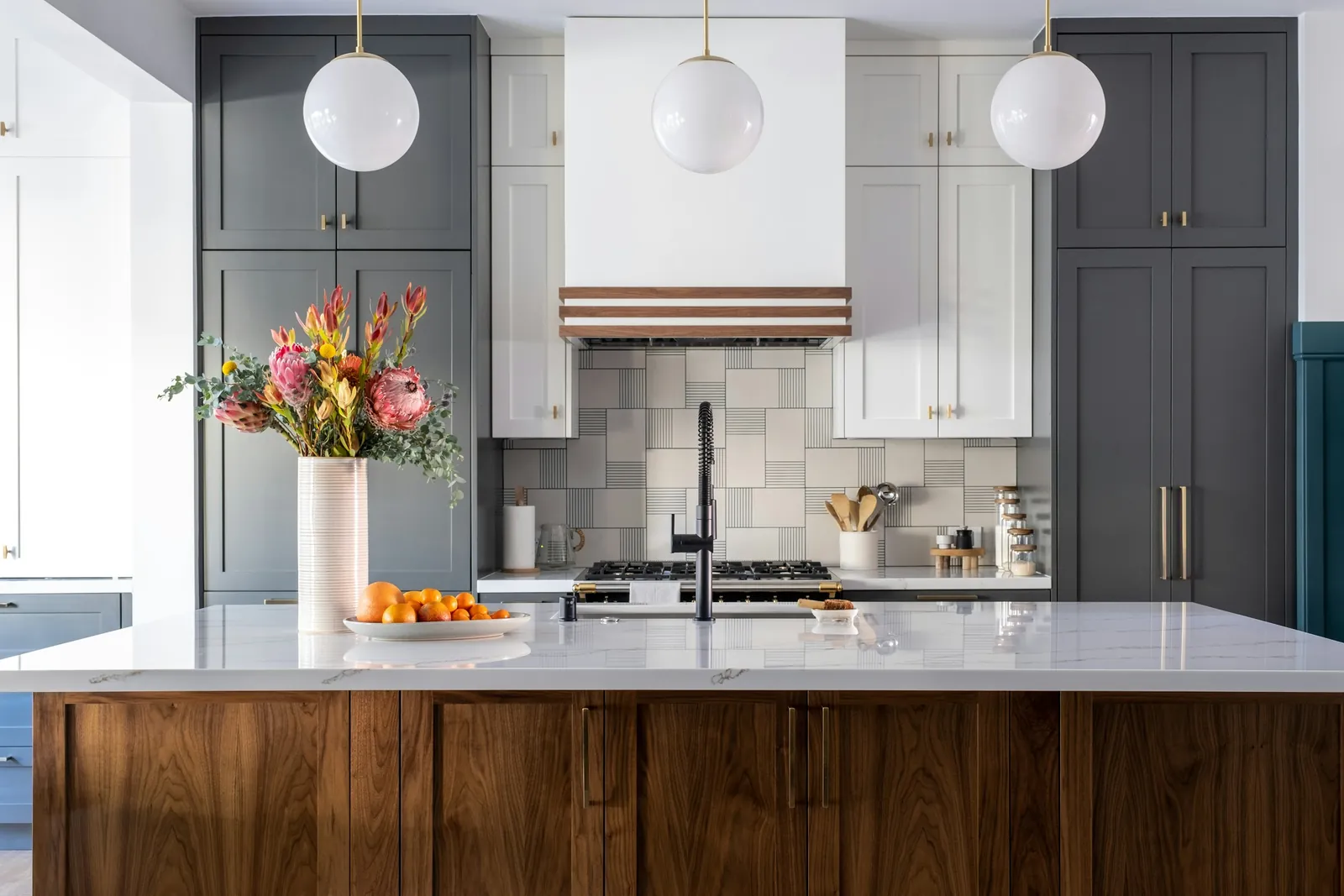
Two-tone cabinets work when one color clearly leads and the second is noticeably lighter or darker, not almost the same. The usual splits are dark lowers with light uppers, a contrasting island, or a single accent run like a pantry wall or hutch.
The idea is easy to like and easy to overdo. Below are the common ways to divide a kitchen, pairings that behave, rules of thumb for keeping the balance right, and what to check before you commit to two colors.
Three ways to split a kitchen
- Uppers and lowers. One color on the wall cabinets and another on the base cabinets. This is the most common split.
- Perimeter and island. The cabinets along the walls share one color, and the island takes the second.
- An accent run. A pantry wall, hutch, bar or sink wall in the second color while everything else stays in the first.
All three work because the seam falls where the kitchen already changes: at the counter, at the edge of the island, at the end of a run. That is the first rule of two-tone design. Let the structure of the kitchen decide where the colors change, and the result reads as planned.
Darker lowers, lighter uppers
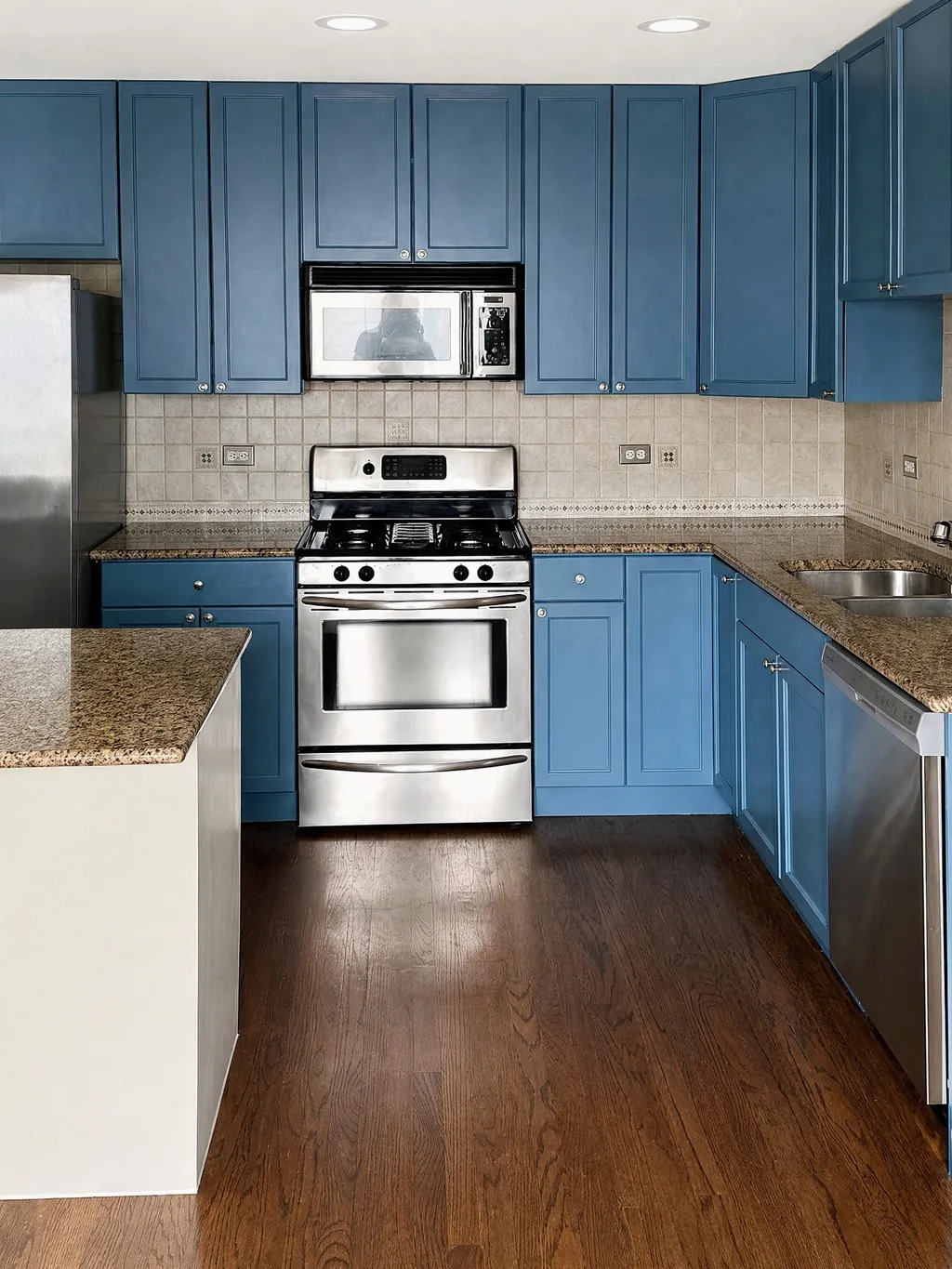
This is the most dependable pairing. A deeper color on the base cabinets anchors the room, and a lighter color overhead keeps the wall cabinets from feeling heavy. It follows the way a room is built: more weight below, less above.
Reversing it, with dark uppers over light lowers, is the rarer choice. It tends to feel top-heavy, and it works best in a tall, bright room where the dark color has space around it. In a compact kitchen, our post on the best cabinet colors for small kitchens goes through what holds up in less space.
Decide the small parts early. End panels, the toe kick, filler strips and any crown molding need a color too. The simplest rule is to match each piece to the cabinet it attaches to, and the exceptions are worth raising on the estimate call so nothing is left to guess.
An island in the second color
The island is the easiest place to start. It stands apart from the walls, so it can look like a furniture piece rather than part of the cabinet run, and a second color on it touches the fewest doors. If you're unsure about two colors, this is the lowest-commitment version.
Pick the island color to pick up something already in the room: a rug, a bit of tile, the dining chairs beyond it. Our post on kitchen island paint colors goes deeper on this one piece.
An island has several sides, and the one you see from the living room matters most. Decide whether the back panel and the ends carry the island color or match the perimeter. A bold color on only the front can look like an afterthought. A stained island with painted cabinets around it is another way to split a kitchen; our post on keeping stained wood or painting it covers when to keep the wood.
Color pairings that tend to work
| Leading color | Second color | The feel |
|---|---|---|
| Soft white | Deep green | Classic, a little traditional |
| White | Navy | Crisp and fresh |
| Light gray | Charcoal or black | Modern and quiet |
| Warm white | Muted sage | Soft and calm |
| Deep green | Cream | Rich, with a light edge |
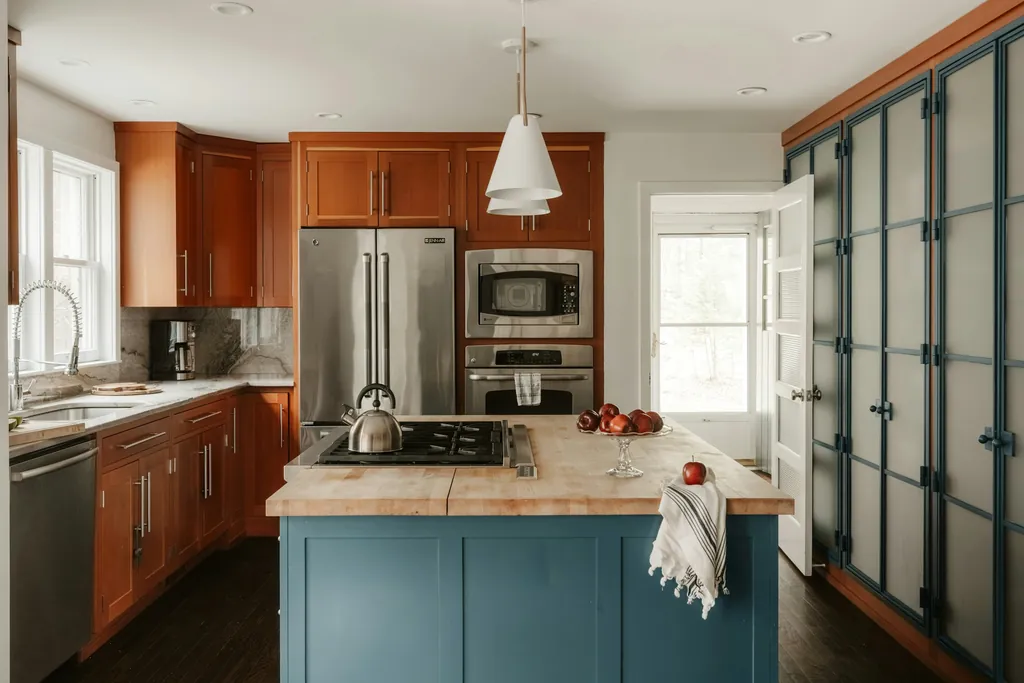
These are directions, not formulas. For more on the two deepest options, see our posts on green kitchen cabinets and navy blue kitchen cabinets. Charcoal or black lowers have their own notes in painting cabinets black. We refinish in any color, one or several. The red built-ins refinished in two shades of green, with black French doors beside them, show how far two tones can go. If you're starting from cherry or maple, see painting cherry cabinets first.
Rules of thumb for balance
- Let one color lead. Give the lighter or more neutral color most of the cabinets and the second color less. Roughly two-thirds to one-third looks planned, while an even split can look undecided.
- Make the contrast clear. Two colors that are almost the same read as a mistake. Choose colors that differ in lightness, not only in hue.
- Change at a natural break. Switch colors at the counter line, the end of a run or the edge of the island, never mid-run and never door by door.
- Keep the sheen the same on both. A matching finish makes two colors look like one design, and our post on the best paint finish for kitchen cabinets helps you pick it.
- Repeat the second color once. A stool, a door, trim or an open shelf elsewhere in the room ties it back to the rest.
- Stop at two. A third color works only as a small, deliberate accent.
If your uppers have glass fronts or open shelves, what shows through is part of the plan too. Our post on whether to paint inside cabinets covers when the inside is worth finishing.
Checking the contrast
Many paint swatches print a light reflectance value, or LRV. Wikipedia defines it as the ratio of the light a surface reflects to the light that hits it, from none to all. Two colors with LRVs close together have little contrast no matter how different their names sound, and two with a clear gap read as distinct.
Light, counters and hardware
Judge both colors in your own kitchen, in the morning and again in the evening, because window light and bulbs change a color more than most people expect. If you're about to change bulbs, do that first. The U.S. Department of Energy notes that moving from a warm 2,700 K bulb to a cool 4,100 K one is a noticeable change.
Start from what isn't changing. A busy counter or a patterned backsplash usually wants calmer cabinets, while plain counters can carry a bolder second color. Plan the pulls at the same time, since hardware is part of the finished look. Our guide to choosing a cabinet color shows five real kitchens working through the same questions.
Hardware can bridge two colors. One metal across every door and drawer, whether black, brass or nickel, gives the eye something that stays constant while the paint changes. Mixing metals along with mixing colors is a lot to ask of one kitchen, so change one thing at a time.
Dark colors and the first few weeks
A deep second color has one practical wrinkle. In a technical bulletin on dry time and cure time, Dunn-Edwards says dark, heavily pigmented colors typically take longer to dry and cure than light ones. Dry and cured are not the same thing: the bulletin puts the full cure of latex coatings at 14 to 30 days.
So treat the darker cabinets gently for the first few weeks. Open doors by their pulls, wipe with a soft damp cloth rather than a scrubber, and don't stack heavy items against fresh paint. Our post on how long it takes to paint kitchen cabinets explains the difference in more detail.
Planning a two-color job
A two-color kitchen gets the same preparation as a one-color kitchen on every cabinet refinishing job: cleaning, degreasing, sanding and priming, with the doors and drawer fronts sprayed and the frames finished in your kitchen. We paint wall and base cabinets in one color or in more than one.
When you ask for a free estimate, describe which cabinets get which color, and have a rough count of cabinets, doors and drawers ready. Cabinet work is priced per cabinet with the paint included, and our guide to how cabinet painting is priced explains what goes into the number.
Common questions
What colors go well together for two-tone kitchen cabinets?
A light neutral with a deeper color is the safest pairing: white with navy or deep green, light gray with charcoal, or warm white with muted sage. Look for a clear difference in lightness, and test both samples together in your own kitchen's light.
Should the darker color go on the top or bottom cabinets?
On the bottom, usually. Darker base cabinets anchor the room and keep the wall cabinets feeling light. Dark uppers over light lowers can feel top-heavy, so that arrangement is rarer and works best in a tall, bright kitchen.
Can I do two-tone cabinets with just the island?
Yes, and it's the lowest-commitment way to try the look. The island is a separate piece in the room, so a second color on it touches the fewest cabinets and is easy to tie to the rest of the kitchen.
How many colors is too many?
Two is the usual limit. A third color can work as a small, deliberate accent, like a single door or a piece of trim, but more than that tends to look scattered rather than planned.
Should both colors have the same sheen?
Usually yes. A matching finish makes two colors read as one design. Different sheens catch light differently, and the contrast can look uneven even when every door got the same care.
Sources
- Dry Time versus Cure Time of Paint (technical bulletin), Dunn-Edwards
- Light reflectance value, Wikipedia
- Purchasing Energy-Efficient Light Bulbs, U.S. Department of Energy, Federal Energy Management Program
More on cabinet refinishing and every cabinets post.