A simple process for picking paint colors, room by room
· 6 min read · By GK Painting & Remodeling
To choose paint colors for your home, start with the things you aren't changing, like floors, counters and cabinets, then narrow to a short list and test each color on your own wall in your own light. Most color regrets come from skipping that last step.
The process below takes a few evenings, not a few weeks. It works for one room or the whole house. If you want the walls, ceiling and trim done properly once you've decided, our interior painting is built for exactly that.
Start with what isn't changing
Every room has fixed elements: the floor, the countertops, the tile, the stone or brick around a fireplace, the big sofa you aren't replacing. Each one has a color and an undertone, and your wall color has to get along with all of them.
Walk the room and write down what you see. Is the oak floor orange or honey? Are the counters warm beige or cool gray? A white that looks fresh next to gray granite can look yellow next to a pink-toned tile. If the cabinets are part of the project, choose their color first, since they're the largest surface in the room. Our guide to choosing a cabinet color works through that decision.
Learn to read undertones
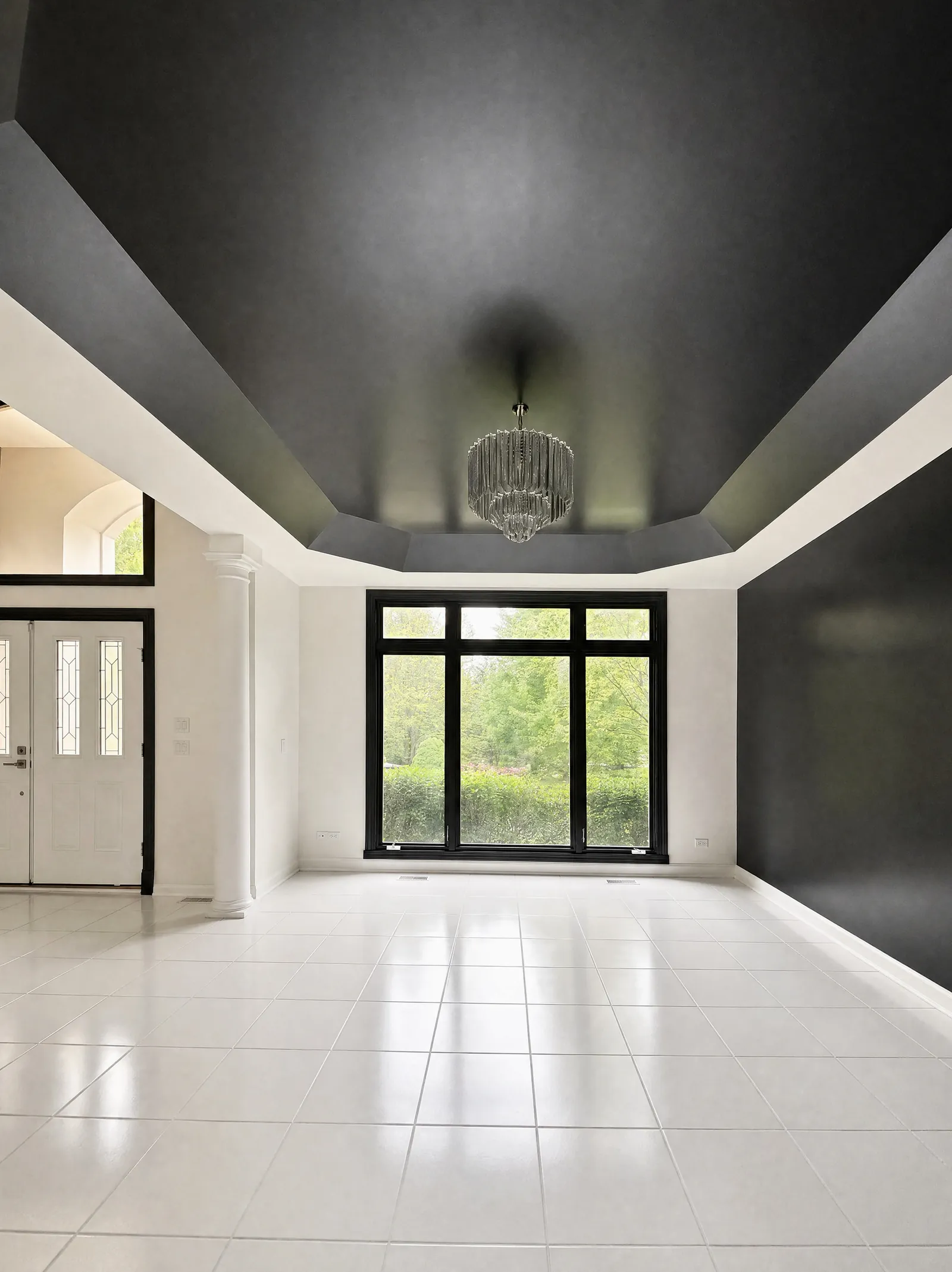
An undertone is the faint hue underneath the main color. A gray can lean blue, green or purple. A white can lean yellow, pink or blue. Benjamin Moore notes that neutrals like white and gray lean warm or cool depending on their undertone, and that comparing colors side by side is the way to spot the difference, since a white with a yellow undertone looks clearly different next to one with a blue undertone.
Try it yourself: lay three or four chips on a white sheet of paper and look for the one that turns green, pink or lilac next to the others. That's the undertone showing. Then hold the chips against your floor and counters. Undertones that clash show up fast in that comparison.
Look at your light
The same paint looks different in every room because light changes it. Benjamin Moore says both natural and artificial light can pull an undertone warmer or cooler, and that the direction a room faces matters when it gets a lot of daylight. Rooms with little natural light depend more on their bulbs.
Bulbs matter more than most people expect. Benjamin Moore notes that bulbs rated above 3500 Kelvin tend to cast a cooler light, and the lower the number, the warmer and cozier the light. A gray that looks soft under a warm bulb can look icy under a bright cool one.
Rooms facing north are their own case, and we've written about paint colors for north-facing rooms separately. Light matters overhead too; our post on matching the ceiling to the walls explains what light reflectance value tells you.
Narrow to three and test on the wall
A chip under store lights tells you very little about your room. Benjamin Moore recommends brushing on a sample and viewing it under every lighting condition the room has, which it describes as the best way to avoid surprises. Here's a simple routine:
- Narrow to three colors, no more. Four or five samples on one wall just confuse the eye.
- Paint each sample at least two feet square, with a white border around it, so the old wall color doesn't bleed into your judgment.
- Put samples on two different walls, since one wall usually gets more light than another.
- Look at them in the morning, at midday, in the evening with your lamps on, and once on a cloudy day.
- Live with them for a couple of days before you decide. Your first reaction isn't always your lasting one.
We have a longer walk-through in our post on how to test paint colors.
Make the rooms flow
The easiest way to make a house feel put together is to choose colors that share undertones, so one room doesn't fight the next. You don't need the same color everywhere. You need rooms that look related when you can see two of them at once, like a hallway and the rooms it opens onto.
- Pick one trim white and use it throughout. It's the thread that ties every room together.
- Choose two or three wall colors for the main living areas, in the same warm or cool family.
- Let bedrooms and bathrooms go a step bolder, since you see them one at a time.
- Stop colors at inside corners or doorways, never in the middle of a flat wall.
- Check every room from the doorway, because that's where you'll see the transition most.
Benjamin Moore adds that in a room that mixes warm and cool, the dominant color sets the room's character, and that trim whites should match the temperature of the walls: a cooler white with cool walls, a warmer one with warm walls. If one room needs two colors, our post on two tone walls shows how to pick the pair.
Think about when you use the room
A room you use at 7am wants something different from a room you use at 9pm. A kitchen or home office that gets most of its use in daylight can take a cleaner, brighter color. A bedroom or living room that's mostly lived in after dark often looks better a little deeper and warmer, since pale colors can look washed out under lamps.
Think about what's on the walls, too. If you hang a lot of art, a quieter color lets it carry the room. If the walls will be mostly bare, you can afford more color. And if the room is small and dim, pushing for a dark, dramatic color can work, but it should be a choice you've tested rather than a hope. A short list and a few samples will tell you quickly.
Sheen changes how a color looks
Sheen is the part people forget. Dunn-Edwards notes that higher gloss makes a color look brighter and richer, and also highlights surface flaws. A flat finish hides wall imperfections better, but stains are harder to remove from it.
So the same color chip becomes a slightly different color in flat and in satin. Pick your sheen before you judge a sample, and test the color in the finish you plan to use. Our explainer on paint sheens covers which sheen belongs where.
Dark colors take more than a good eye
A deep color can make a room feel rich, but it asks more of the paint job. Dunn-Edwards says dark colors with a high pigment load generally take longer to dry and cure than light ones, so there's more waiting between coats and more care in the first few weeks.
Going the other direction is a different problem. If your walls are dark now and you want them light, read our post on painting over dark paint before you choose. A bold accent can work well on one wall, and our accent wall ideas show which walls take it best.
Once you've decided
Tell us the color name and the brand when you call. We use premium paint from Sherwin-Williams and Behr, and Behr is the more economical of the two. If your color is from another brand, that's fine too; your written quote is built around the paint you pick.
Floors and furniture are covered first, small holes are repaired, and most rooms take one to two days. When you're ready, ask for a free estimate and George will talk through what you have in mind.
Common questions
How many paint colors should a house have?
Usually one trim white, two or three wall colors for the main living areas in the same warm or cool family, and a few bolder choices for bedrooms or bathrooms. What matters is that rooms you see together share an undertone.
Should every room be the same color?
No. Using one color everywhere is simple, but it isn't necessary. Related colors in different rooms give the house some variety while keeping it calm, as long as they share a warm or cool lean.
How do I pick the right white?
Compare whites side by side, because the undertone only shows against another color. Match the white to your trim and to the temperature of your walls, then test it on the wall in the room's own light.
Do paint colors look different at night?
Yes. Artificial light changes how an undertone reads, and bulbs rated above 3500 Kelvin tend to cast a cooler light than lower-rated ones. Look at your samples in the evening with your lamps on before you commit.
How big should a paint sample be?
Big enough to judge, which means at least two feet square. A small swatch can't show you how the color behaves across a wall, in corners or next to your trim.
Sources
- Guide to Warm and Cool Paint Colors, Benjamin Moore
- Selecting Paint Gloss, Dunn-Edwards
- Dry Time versus Cure Time of Paint (technical bulletin), Dunn-Edwards
More on interior painting and every interior painting post.