Powder room paint colors for a small room that can take a risk
· 6 min read · By GK Painting & Remodeling
A powder room is the best place in the house to be bold, and deep, saturated colors such as terracotta, forest green, navy and plum are what work best in one. The room is small, guests spend minutes in it, and with no tub or shower it's easier on paint than a full bathroom.
Here's why small rooms handle strong color so well, which colors to consider, how lighting and sheen change the result, and what the painting involves. If you'd like it done for you, our interior painting service covers small rooms as well as big ones.
Why a powder room can handle bold color
Wikipedia's article on bathrooms describes a half bath, or powder room, as a room with just a toilet and a sink. That makes it small, short-stay and low-moisture next to a full bath, so the room asks little of its paint and gives you a lot of room to play.
Small rooms are also self-contained. You step in and close the door, so the color doesn't have to flow into the next room the way a living room's does. A bold wall color with the ceiling and moulding painted to match is fair game, and the effect is more like a jewel box than a bathroom.
Colors that work
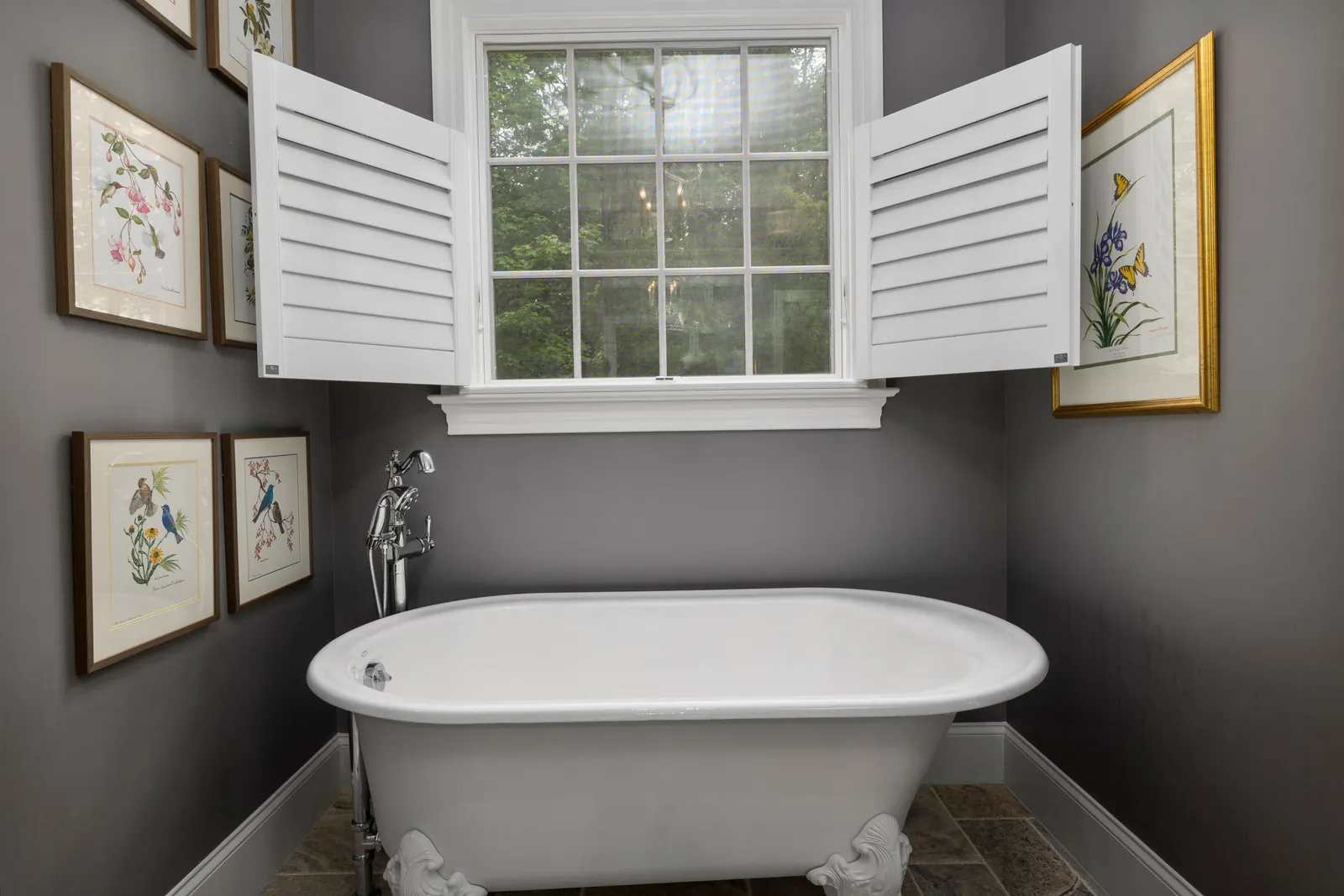
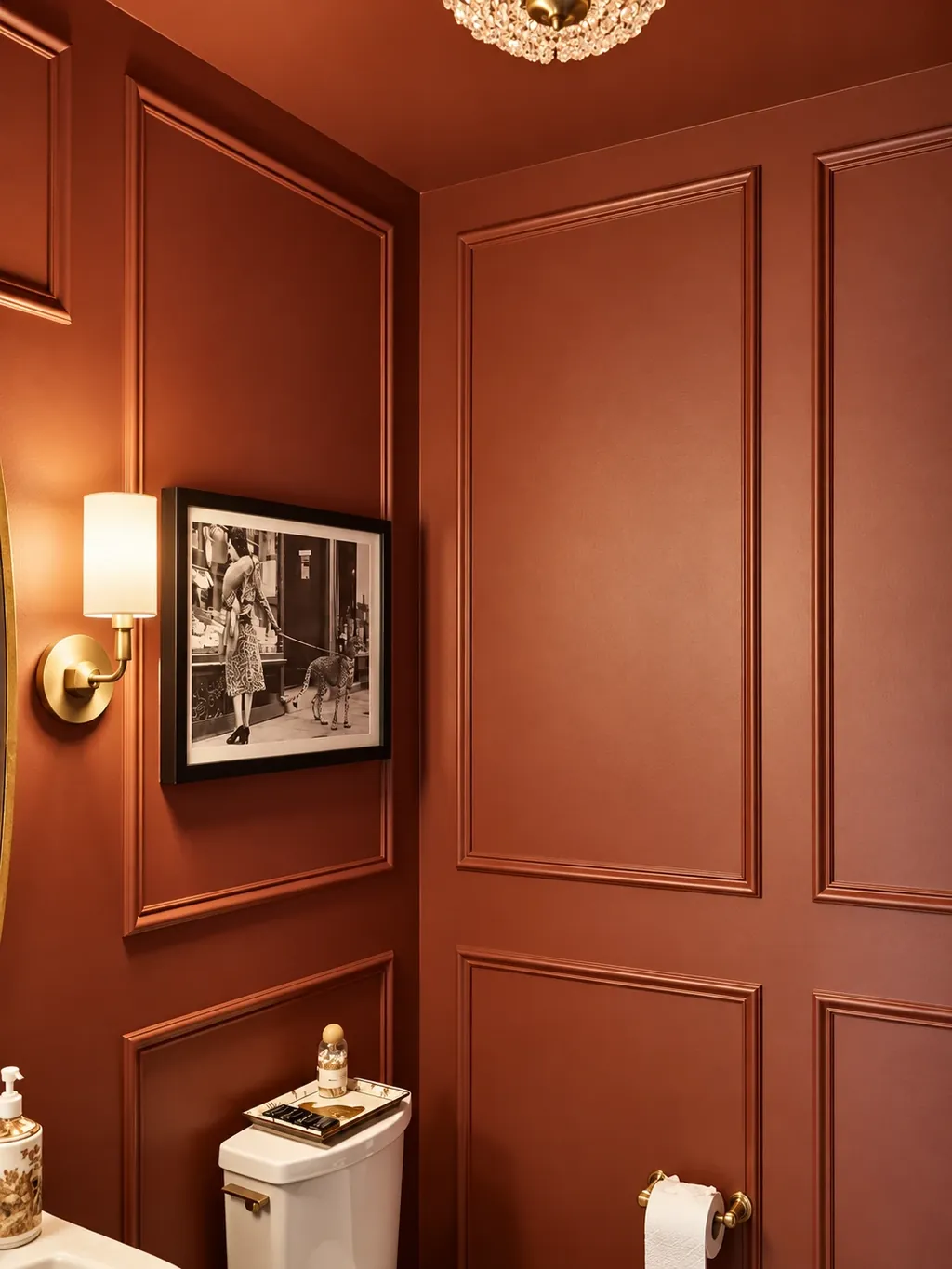
The powder room in the photo on this page is painted deep terracotta, with the walls, panel moulding and ceiling all in the same color, and it's a good example of how far a small room can go. A few other directions to consider:
- Terracotta and clay. Warm and earthy, and they look especially good next to brass and a framed mirror.
- Forest or bottle green. Rich and calm, and a natural partner for white fixtures.
- Navy and ink blue. A dark neutral that feels modern and a little formal.
- Plum and aubergine. Unexpected, and surprisingly easy to live with by lamplight.
- Charcoal and black. Dramatic, and more forgiving than you'd think in a room with warm bulbs.
- Dusty rose or sage. For people who want color but not drama.
Pick the color for the mood, not the size of the room. A dark color doesn't shrink a small room so much as make its walls less noticeable, which is often what you want from a space you pass through.
If bold isn't for you
A softer powder room is a fine choice too. Warm white, soft greige and pale sage all keep a small room light. If the room has no window, a pale color can read gray instead of bright, because there's no daylight to lift it, so choose one with a little warmth and test it under the vanity light. Our post on paint colors for north-facing rooms explains how undertones behave in dim light.
Pairing the color with what's already in the room
A powder room is full of things you aren't repainting: the vanity top, the sink, the floor, the faucet, the mirror frame. Your color has to get along with all of them, and their undertones matter as much as their colors.
- Brass, gold and copper. They glow against terracotta, forest green, plum and deep brown.
- Chrome and nickel. They suit navy, charcoal and cooler greens.
- Black fixtures. They look sharp against almost anything, and especially against warm whites and pale colors.
- Wood vanities and trim. Warm wood and terracotta or green sit well together, while a cool blue can clash with an orange-toned wood.
- Marble, stone and tile. Hold your sample against them in the room's own light, since white and gray stone carry hidden warm or cool tones.
Bring the sample to the vanity top and the floor and look at all three together. If the paint makes the stone look dingy, change the paint, not the stone.
Lighting is half the color
If your powder room has little or no window, the vanity fixture does the work, and the bulb in it matters as much as the paint. The U.S. Department of Energy explains that the Kelvin number on a bulb tells you how warm or cool the light looks: higher numbers look cooler and bluer, lower numbers look warmer and more yellow, and the warm end resembles incandescent light. Wikipedia lists soft white bulbs at 2,700 K and warm white at 3,000 K.
In a deep terracotta, green or plum, warm bulbs make the color glow. Cool daylight bulbs, at 5,000 K and above, flatten it and push it toward blue. Swap in the bulbs you plan to keep before you judge your samples, because changing them later changes the color.
Sheen, splashes and humidity
A powder room has no shower, so steam isn't the problem it is in a full bath, where paint for bathroom walls has more to handle. Hands, splashes and sink-side wear are. The EPA recommends keeping indoor humidity below 60 percent, ideally between 30 and 50 percent, and says that in damp rooms like bathrooms, running a fan or opening a window to increase ventilation helps keep mold from coming back. If your powder room has a fan, use it.
For the sheen, satin or semi-gloss wipes clean around the sink. A matte finish looks richest in a deep color but marks more easily, so it suits a room with light use. Our guides to paint finish for each room and how to paint a bathroom go through the choices.
Walls, ceiling, trim and door
In a bold powder room, the color usually goes everywhere. There are three common approaches:
- One color on everything. Walls, ceiling, trim and door in the same shade erase the edges and make the room look built that way.
- A deep wall with white trim and ceiling. Crisp, traditional and easy to repaint.
- A deep wall with a lighter ceiling. A pale tint of the wall color lifts the room without a hard contrast line.
A small room has more edges per square foot than a large one: around the toilet, behind the tank, along the vanity, around the mirror and the door casing. Cutting in takes a bigger share of the day, and that's where a careful hand shows. Our guides to painting baseboards and painting interior doors cover the trim and the door.
Prep and painting a small room
Before any paint, the mirror, towel bars, art and anything else on the walls come down. Floors and fixtures are covered, the holes from old hardware are repaired, and the surfaces are cleaned, sanded and primed. A deep color over a light wall usually needs a primer and enough coats to cover evenly, so the prep decides how rich the finish looks.
Drying matters in a closed room. Dunn-Edwards says dark, heavily pigmented colors typically take longer to dry and cure than light ones, and that high humidity slows the drying of latex coatings. Leave the door open and run the fan while the paint dries. Most rooms take one to two days, and a powder room is a small one.
Test it, then get it painted
- Paint a large sample, at least two feet square, on the wall opposite the vanity.
- Look at it with the door closed and the lights on, the way a guest would.
- Check it next to the fixtures and floor, not just a white board.
- Live with it for a few days before you commit.
Our guide to how to test paint colors goes into each step.
Remember the view from outside, too. A powder room usually opens off a hall or entry, so the color is seen through the doorway before anyone steps in. Stand where a guest would and check that it works with the hall color and the rooms around it. Our guide to how to choose paint colors for your home covers how to make colors flow from one room to the next.
Interior painting is priced by the square footage of the space, with paint included. We paint homes and businesses across Madison and Dane County, including Monona, and you can ask for a free estimate to talk through your colors.
Common questions
What color should I paint a powder room?
Take a risk. Deep terracotta, forest green, navy and plum all work well in a small room. Choose by mood and test a large sample with the door closed and the vanity light on.
Will a dark color make a small powder room feel smaller?
It tends to make the walls less noticeable rather than shrink the room. In a room you pass through for a few minutes, that's often what you want. Warm bulbs keep it from feeling closed in.
Should the ceiling and trim match the walls?
They can. One color on walls, ceiling, trim and door feels built-in and dramatic. A white ceiling and trim gives a crisper look and is easier to repaint later.
What sheen is best for a powder room?
Satin or semi-gloss wipes clean around the sink. Matte looks richest in a deep color but marks more easily, so it suits a room with light use.
Does a powder room need special paint for moisture?
With no shower, a powder room is easier on paint than a full bath, but it still helps to vent moisture. The EPA recommends keeping indoor humidity below 60 percent, ideally between 30 and 50 percent, and notes that running a fan or opening a window helps in damp bathrooms.
Sources
- Bathroom (half bath and powder room), Wikipedia
- Consumer Guide to Energy-Efficient Lighting, U.S. Department of Energy
- Color temperature, Wikipedia
- A Brief Guide to Mold, Moisture, and Your Home, U.S. Environmental Protection Agency
- Dry Time versus Cure Time of Paint (technical bulletin), Dunn-Edwards
More on interior painting and every interior painting post.